
London’s Specialist in Period Sash Windows & Doors
Queens Park, London — Edwardian Sash Window Restoration
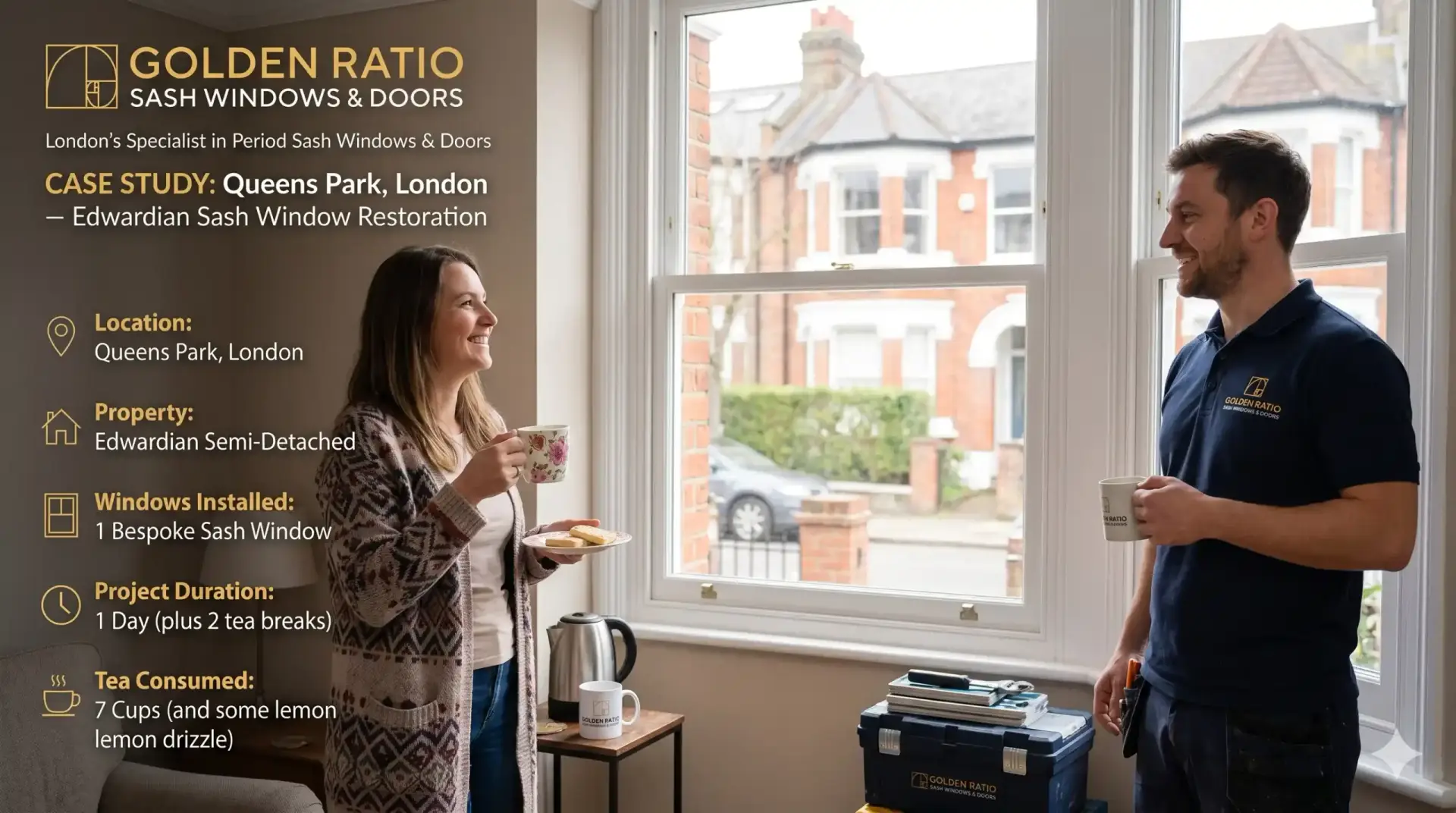
Location
Property Type
Project Duration
Windows Installed
Queens Park,
London
Edwardian Semi-Detached
1 Day (plus 2 tea breaks)
1 Bespoke Sash Window
Project Overview
Some jobs arrive as a straightforward phone call: one window, one address, one day’s work. This was one of those jobs — on paper. In practice, it turned into one of the most memorable installs of the year, for reasons that had very little to do with the window itself.
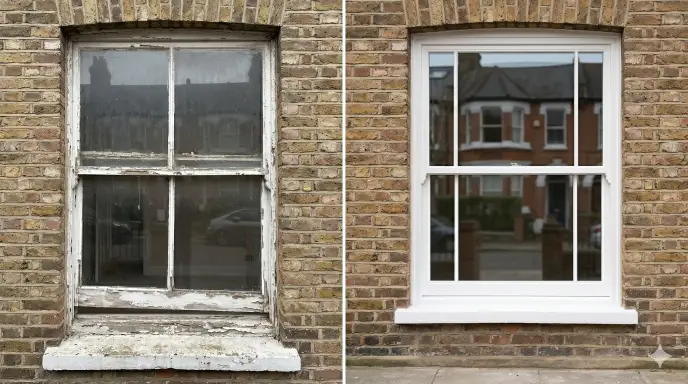
The client, a homeowner on a quiet residential street in Queens Park, had an original Edwardian sash window in the front reception room that had seen better days. The sashes had been painted shut at some point in the 1990s (a crime against joinery that we see more often than we’d like to admit), the lower sash had developed a noticeable lean, and there was a draught that, according to the homeowner, “could chill a glass of white without the fridge.”
Golden Ratio Sash Windows & Doors were brought in to supply and install a bespoke replacement sash window — sympathetically designed to match the original Edwardian proportions, with slim sightlines, traditional run-through horns, and a smooth spiral balance system to make the sashes glide effortlessly for years to come.
The Property
The house itself is a classic Queens Park Edwardian semi-detached — the kind of property that has survived two world wars, several ill-advised extensions, and the full horror of 1970s interior design largely intact. High ceilings, original cornicing, and a facade that has somehow kept its dignity despite the double-yellow lines creeping up the street outside.
These Edwardian properties are a pleasure to work on. The original joinery was built to last, and when it’s finally time to replace a window after 100-plus years of service, you want to make sure the replacement is worthy of what it’s replacing. Off-the-shelf uPVC was never going to cut it here — and to the homeowner’s credit, they knew that from the outset.
The front elevation faces north-west, which means the window takes the full force of London’s more enthusiastic weather. The existing frame showed the expected wear: paint build-up across the sash meeting rails, a slight twist in the lower sash, and glazing putty that had given up the ghost about fifteen years ago.
The Solution
Following a full survey of the existing opening, our team designed a bespoke hardwood sash window to the following specification:
Engineered hardwood frame — finger-jointed Accoya for outstanding stability and paint adhesion
Traditional Edwardian proportions — matching original glazing bar layout and horn profile
Spiral balance system — replacing the original (and long-expired) box sash weights
Double-glazed units — slim-line 4/6/4mm to maintain original sightlines
Draught-proofing brush seals — fitted to all four sides
Factory primed in white — ready for the client’s chosen top coat
The window was manufactured at our London workshop and delivered to site on the morning of the installation — a process that, under normal circumstances, takes approximately one working day from first fix through to final seal.
These were not, as it turned out, entirely normal circumstances.
The Job Itself: A Story in Several Cups
Our lead installer, Jamie, arrived at 8:15am. He rang the bell, introduced himself, and had barely finished explaining the day’s plan before the homeowner — let’s call her Margaret, because she had that energy — vanished into the kitchen and reappeared forty-five seconds later carrying a tray, two mugs, a small plate of shortbread, and the kind of expression that made it clear refusal was not an option.
“You’ll need fuel before you start. Sit down, sit down. I made a pot.”
Cup of tea number one was consumed at 8:20am, standing in the hallway, before a single tool had been unpacked.
By 9:30am, with the old window successfully removed and the opening prepped, Margaret returned with a second round. This one came with biscuits described as “homemade—well, mostly. I used the packet mix but I added vanilla.” Jamie accepted graciously. His colleague Lee, perched on a step ladder with a chisel, accepted slightly less graciously, having just achieved perfect focus on a particularly stubborn section of frame.
The installation itself proceeded beautifully. The new frame dropped into the opening with the satisfying snugness that only comes from a properly surveyed, properly made window. Fixing, sealing, beading — everything went to plan. At approximately 11:15am, with the new sashes hung and the spiral balances adjusted, Jamie demonstrated the window to Margaret: a smooth, effortless glide, both sashes moving exactly as they should.
Margaret was delighted. She opened and closed the lower sash four times in quick succession with an expression of pure joy.Then she went to put the kettle on.
“That’s marvellous. Absolutely marvelous. Now, you must stay for a proper cup. Not a quick one — a proper one. I’ve got cake.”
There was cake. A lemon drizzle, as it happened. Jamie later described it as “genuinely one of the better ones I’ve had.”
By 12:30pm, the installation was complete, the site was clean, and the team had consumed a combined total of seven cups of tea, two rounds of biscuits, and a generous slice of cake each. Margaret had also, at one point, asked if anyone wanted soup (“I’ve got a lovely tomato on”), which was politely declined on the grounds that they were already behind schedule.
The window looked exactly as it should: period-correct, beautifully proportioned, and completely at home on the front of a 115-year-old Edwardian semi. Queens Park was restored to its former glory, one sash at a time.
Results at a Glance
Measure
Before
After
Draught Rating
Significant gaps
Fully sealed
Noise Reduction
Road noise audible
Noticeably quieter
Operation
Stiff, paint-seized
Smooth, effortless
Kerb Appeal
Tired, mismatched
Restored, period-correct
Queens Park, London
N/A
7 (not all voluntary)
Client Feedback
“I was nervous about having the window replaced — the house is over a hundred years old and I didn’t want anything that looked wrong. Golden Ratio were brilliant from the survey right through to the finish. Jamie and Lee were tidy, professional, and incredibly patient. I may have slowed them down slightly with the refreshments but they never complained once. The window is perfect. I couldn’t be happier.”
— Homeowner, Queens Park, London
Why Golden Ratio Sash Windows & Doors?
At Golden Ratio, we specialise exclusively in sash windows and doors for period London properties. Every window we make is bespoke — surveyed, designed, and manufactured specifically for the opening it will live in for the next hundred years.
We understand that for homeowners with Edwardian, Victorian, or Georgian properties, replacing a window isn’t just a maintenance decision. It’s a commitment to the character of the building. That’s why we never use off-the-shelf units, never rush a survey, and never fit a window we wouldn’t be happy to put our name on.
We also, as this case study demonstrates, never turn down a cup of tea.